
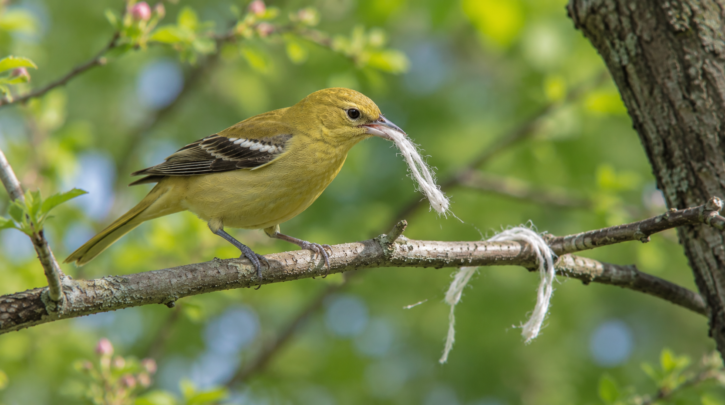

Because orioles weave their nest from long, flexible fiber rather than building with twigs or grass alone, offering nesting material is one of the more direct and genuinely effective ways to support a nesting pair — a practice with no real equivalent for cavity nesters like bluebirds.
What to Offer
- White cotton string or yarn, cut into short pieces roughly 4 to 8 inches long
- Natural plant fiber such as raffia or milkweed floss
- Horsehair or other natural animal hair, if available
- Strips of soft, undyed cotton fabric
The Length Rule: Keep It Short
Length is the single most important safety consideration. Pieces longer than about 8 inches create a real entanglement risk — a long strand can wrap around a bird’s leg, wing, or neck during weaving, or around a chick inside the finished nest. Cutting material down to short, manageable lengths before offering it removes most of this risk while still giving orioles genuinely useful weaving material.
What to Avoid
- Dryer lint — it breaks down quickly, retains moisture and can grow mold inside a nest, lacks structural integrity for weaving, and can carry residue from detergents and fabric softeners
- Fishing line or other monofilament — a serious entanglement and strangulation hazard for both adults and chicks
- Synthetic fibers that don’t break down naturally and can trap moisture against eggs or chicks
- Any string, thread, or yarn longer than roughly 8 inches, regardless of material
- Treated, dyed, or chemically processed fibers that could introduce chemical exposure inside the nest
Why Dryer Lint Specifically Gets Recommended Against
Dryer lint is a commonly repeated tip in general backyard-bird content, but it’s a poor choice for orioles specifically. It lacks the tensile strength needed for the kind of structural weaving an oriole nest requires, it absorbs and holds moisture in a way that can promote mold growth inside an occupied nest, and it can carry trace residue from laundry products that isn’t something you want in direct, prolonged contact with eggs or chicks.
How to Present the Material
A suet cage, a mesh onion bag, or a dedicated nesting-material dispenser all work well, holding cut pieces loosely enough for a bird to tug individual strands free without the whole bundle coming apart at once. Simply draping a loose handful over a visible branch is a low-effort alternative that also works, provided the pieces are already cut to a safe length.
Timing
Put material out in spring, timed to coincide with the arrival of returning orioles and the start of the nest-building window covered in our nest guide. Material offered well before or after this window is less likely to be used, since orioles only actively gather nest fiber during the relatively short construction period.
Placement
Position the material source somewhere visible and easily reached, ideally within sight of the same feeding station where you’re already offering nectar or jelly — a bird that’s already visiting regularly is more likely to notice and use a nearby material source than one placed somewhere the bird has no other reason to visit.
Want to know where that material actually ends up? Revisit our nest guide for how the weaving process comes together over one to two weeks.
How Much Material to Offer
A modest bundle — roughly a handful of cut pieces refreshed every few days during the active nest-building window — is generally enough. Offering an overwhelming amount at once isn’t necessary and doesn’t meaningfully speed up construction; a female oriole gathers material gradually over the one-to-two-week building period rather than all at once.
Color Preferences
White or light-colored string and yarn appear to be favored over darker colors in many documented cases, though orioles will use a range of colors if that’s what’s available. Sticking to white or naturally colored, undyed materials is a reasonable default both for visual appeal and to avoid introducing unnecessary dye chemicals into the nest.
Signs the Material Is Being Used
A material dispenser that’s steadily emptying over the course of the nest-building window is a good sign of active use, and it’s sometimes possible to spot bright white or colored strands woven visibly into a distant nest through binoculars, confirming the material made it into the finished structure.
A Practice Unique to Open-Cup and Pouch Nesters
Offering nesting material has no real equivalent in cavity-nesting species like bluebirds, which build a compact grass cup inside an enclosed box rather than an exposed woven structure. It’s a distinctly oriole-friendly (and more broadly, open-nesting songbird-friendly) way to directly support nest construction, rather than simply providing food and habitat and waiting to see what happens.