
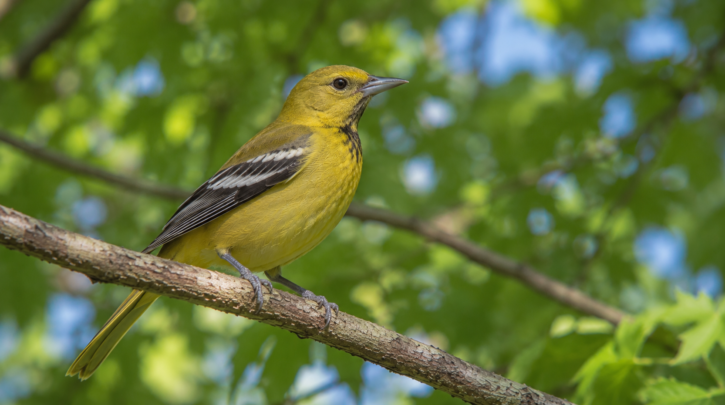

Oriole sexes are more visually distinct than almost any other common backyard bird — but the twist is that young males take a full extra year to catch up to adult male coloring, which trips up a lot of people trying to sex a bird by color alone.
The General Rule: Black vs. No Black
Across all three species, adult males show substantial black in their plumage — on the head, back, wings, throat, or some combination — while adult females show little to none. Female orioles instead carry a warmer yellow, olive, or grayish tone throughout, without the sharp black-and-orange contrast that defines an adult male.
Baltimore Oriole
- Male: solid black head, back, and wings against flame-orange underparts and tail corners
- Female: yellow-orange underneath with a grayish-brown back and duller wings — no black at all
Bullock’s Oriole
- Male: black eye-line, crown, and throat stripe against an orange face and body, plus a large white wing patch
- Female: grayish-yellow overall, more muted and grayer-backed than a Baltimore female
Orchard Oriole
- Male: black head, back, and wings against deep chestnut underparts
- Female: yellow-green overall with no black anywhere — the most subtly marked female of the three, easily mistaken for a warbler or tanager
The First-Year Male Problem
This is where oriole sexing gets genuinely tricky. Male orioles don’t acquire full adult black-and-orange plumage until their second year of life, so a first-year male in his first breeding season looks almost entirely like a female — yellow-olive overall — except for a small, irregular patch of black feathers appearing on the throat. That partial black throat patch is the single clearest way to identify a first-year male rather than an adult female.
Why the Delayed Plumage Exists
Delayed plumage maturation, as ornithologists call it, is relatively unusual among North American songbirds and is thought to reduce aggression from older, more dominant males toward first-year males competing for territory and mates — by looking female-like, a young male may face less direct competition while still being capable of breeding in his first year.
Behavior Can Help Too
During the nesting season, the female does virtually all of the elaborate pouch-nest weaving herself, so a bird spending long, repeated stretches gathering and weaving fiber into a hanging nest is almost always the female. Males spend more time singing from nearby perches and delivering food once chicks have hatched.
Telling Juveniles From Adult Females
Juvenile orioles of both sexes resemble the adult female’s yellow-olive coloring right after fledging, without the black throat patch a first-year male will eventually show as it matures later that same season or into the following year. A juvenile with a fully clean yellow-olive throat and no black at all is most safely aged simply as “young of the year” rather than confidently sexed.
Watching a female build a nest? See our nest guide for how the woven pouch comes together and what to expect over the following weeks.
Molt Timing Through the Year
Adult males keep their bold black-and-orange plumage through both the breeding season and much of the year, with a post-breeding molt in late summer refreshing feathers before migration rather than changing the overall pattern. First-year males, by contrast, undergo a much more visible transformation, gradually acquiring more black feathers on the throat and head across their second year until they reach full adult coloring by their second breeding season.
Comparing Second-Year Males to Full Adults
A second-year male, midway through acquiring adult plumage, can show a patchy, uneven mix of black and yellow-olive feathers that looks distinctly different from either a clean first-year male or a fully colored older adult. This intermediate stage is a normal part of the multi-year maturation process and isn’t a sign of illness or hybridization, even though the patchy appearance can look unusual at first glance.
Using Sex to Interpret Nesting Activity
Because females do the overwhelming majority of nest construction, watching which bird is doing the weaving is a reliable, non-invasive way to track nesting progress from a distance. A male spending most of his time singing from a nearby perch rather than gathering nest material is behaving entirely normally — his contribution comes later, primarily in feeding the female during incubation and both parents feeding chicks after hatching.
When Sex Is Genuinely Hard to Call
A quick, distant look at a yellow-olive bird without a visible throat patch can leave real ambiguity between an adult female and a first-year male, particularly in poor light. In these cases, watching behavior over a longer stretch — whether the bird sings persistently, whether it’s actively weaving nest material — is often more reliable than a single brief plumage check.