
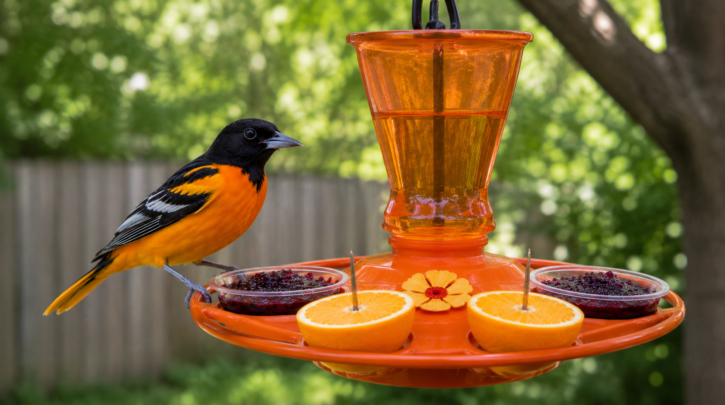

A dedicated oriole feeder looks similar to a hummingbird feeder at a glance, but the details matter. Before getting into specific picks, see our full feeder setup guide for what separates a feeder built for orioles from one that just happens to be orange.
What We Looked For
- Feeding ports sized for an oriole’s larger bill, not scaled down for hummingbirds
- Sturdy perches, since orioles feed while perched rather than hovering
- Dedicated, shallow jelly wells rather than a deep container
- A spike or dish for orange halves
- Easy disassembly for cleaning
Duncraft Ultimate Oriole Feeder
A genuine all-in-one design that offers all three foods orioles actually eat: nectar in the central basin, jelly in four built-in trays, and spikes for four orange halves, all accessible from four circular perches. A built-in ant moat on the hanger keeps the sweet contents from turning into an ant magnet, and the whole feeder snaps apart for cleaning.
See: Duncraft Ultimate Oriole Feeder
Duncraft Eco-Oriole Fruit & Jelly Feeder
A simpler, roofed design focused specifically on jelly and orange halves rather than nectar — two clear dishes hold jelly while an overhanging roof shelters the food from rain, and orange halves skewer onto built-in spikes. Its straightforward two-food focus makes it a good pairing alongside a separate nectar feeder for hosts who want more capacity in each food type.
See: Duncraft Eco-Oriole Fruit & Jelly Feeder
BirdsChoice Oriole Fest Feeder
A four-station design offering nectar, jelly, and an orange-half hook together, with a generous perch at each feeding position and a built-in ant moat. The high-impact plastic construction holds up well across a full season, and the clear basin makes it easy to check nectar level without opening the feeder.
See: BirdsChoice Oriole Fest Feeder
What to Pair With a New Feeder
A feeder alone only covers part of what orioles need. If you have the space, mature deciduous trees for nesting matter just as much as the feeder itself — see our habitat guide for what kind of trees to prioritize, and our nesting material picks if a pair does settle in nearby.
A Note on Color
Orange is the dominant color across nearly every dedicated oriole feeder for a good reason — orioles are visually drawn to it the way hummingbirds are drawn to red. A feeder in a muted or neutral color, even with the right port size and jelly access, may simply take longer to be noticed by passing birds.
Comparing Feeder Capacity
Smaller dish-style feeders need refilling more often but cost less upfront, while larger reservoir-style feeders hold enough nectar or jelly to go several days between refills during slower periods. For a first-time host still learning local oriole traffic patterns, starting with a smaller, less expensive feeder and upgrading capacity once visit frequency becomes clear is a reasonable way to avoid overbuying before knowing how much demand to expect.
Already have a feeder up? Check our jelly and fruit feeder guide if you want dedicated, higher-capacity jelly and orange stations alongside your nectar feeder.
One Feeder or Several
A single well-stocked all-in-one feeder is plenty for most residential yards. On larger properties, or in areas seeing heavy migration traffic in spring and fall, splitting nectar and jelly across two or three separate stations tends to reduce competition and gives more visiting birds low-stress access at once.
Hanging Location and Setup
Hang a new feeder within view of a mature tree, ideally in partial shade to slow both nectar spoilage and jelly softening on hot days. A location visible from a window is also worth considering, since a well-placed feeder often becomes one of the more rewarding things to watch over the course of a season once orioles find it reliably and start visiting on a predictable schedule.
Cleaning Frequency by Feeder Type
All-in-one feeders combining nectar and jelly generally need more frequent attention than a simpler single-food feeder, since nectar spoils faster than jelly and both components need checking on their own schedule. Plan on a full clean every few days during warm weather, more often during a heat wave, regardless of which specific model you choose for your yard.
Budget Considerations
Prices for a well-built oriole feeder vary depending on capacity, number of food types offered, and construction material. A simple single-purpose jelly or nectar feeder is usually the most economical entry point, while an all-in-one combination feeder costs more upfront but consolidates everything into one hang point and one cleaning routine.
Replacing Worn Parts
Over a full season of sun exposure, plastic feeder components can fade or become brittle, and rubber gaskets or seals around nectar reservoirs may need occasional replacement to prevent leaks. Buying from a manufacturer that sells individual replacement parts, rather than only complete units, can extend a feeder’s useful life by several seasons beyond what the base unit alone would otherwise last, which is worth checking before committing to a particular brand.