
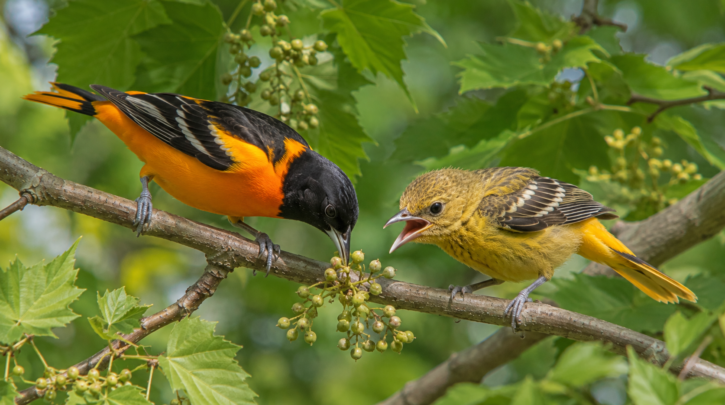

Summer covers the entire arc of a typical oriole nesting attempt — incubation, a notably fast nestling period, fledging, and then a genuine dietary shift as the season progresses toward fall migration.
Incubation and Hatching
Eggs laid in late spring hatch roughly 12 to 14 days later, incubated entirely by the female. See our eggs guide for the full incubation timeline.
A Notably Fast Nestling Period
Oriole chicks fledge just 12 to 14 days after hatching — considerably faster than a bluebird’s typical 17 to 21 days, an adaptation thought to reduce the time chicks spend exposed in a swaying, open pouch nest rather than an enclosed cavity. See our baby orioles guide for the full hatching-to-fledging timeline.
Since Orioles Are Usually Single-Brooded
Unlike a bluebird pair juggling two or three broods across a season, most oriole pairs raise just one successful brood, so a successful early-summer fledging generally means the breeding season — for that pair, at least — is effectively complete for the year. A pair whose first attempt fails may try again, but a successful first brood is rarely followed by a second nesting effort the same summer.
The Dietary Shift Begins
As summer progresses, orioles increasingly turn from insects toward fruit and nectar, building the energy reserves that will eventually fuel fall migration. See our diet guide for the full seasonal breakdown — this is also when jelly and orange-half feeders tend to see their heaviest activity of the year.
Family Groups After Fledging
Once young fledge, it’s common to see the whole family — both parents and several young — moving and foraging together in the same general area for a couple of weeks before the young become fully independent.
Post-Breeding Molt
Adults begin a post-breeding molt in mid-to-late summer, replacing feathers worn from the demanding nesting season before the physical demands of migration begin. This molt typically finishes before or during early fall migration, leaving birds in fresh condition for the long journey ahead.
Watching for Early Departures
Orchard Orioles are notably early fall migrants, and it’s not unusual to see them departing breeding areas by mid-to-late summer, even while Baltimore and Bullock’s Orioles are still actively feeding fledged young nearby. See our migration guide for the species-by-species departure timing.
A Season Worth Documenting
Because the entire nesting cycle compresses into just a few summer weeks, keeping simple notes — arrival date, first egg, hatch date, fledge date — builds a genuinely useful record over multiple years, making it easier to spot whether local timing is shifting earlier or later from one season to the next, especially as spring arrival dates continue to shift gradually with the broader climate over time.
Keep feeders especially well stocked through late summer — see our feeder guide for how to support the pre-migration fueling period that’s about to begin.
Guarding Against Cowbird Parasitism
Summer is also when cowbird parasitism risk is highest, since a cowbird female needs an active host nest with eggs already present to time her own laying correctly. See our predator guide for how orioles’ documented ability to recognize and reject cowbird eggs functions as a real, if imperfect, defense during this window.
Water Needs in Summer Heat
Hot summer weather makes a reliable water source more valuable than at any other point in the year, both for adults and for parents making frequent trips to feed a demanding brood. A shallow birdbath or, better, a dripper that creates movement, tends to draw more consistent attention than a completely still water source during the hottest stretches of summer, when natural water can also be harder for birds to find.
Monitoring From a Distance
Because the pouch nest is elevated and defended by a territorial pair, the safest way to track progress through summer is watching feeding-visit frequency from the ground with binoculars rather than approaching the nest directly. A steady stream of visits is a good sign; a sudden, sustained drop can indicate a problem worth noting, even without direct access to check.
A Season That Moves Fast
Compared to the extended, overlapping-brood summer a bluebird pair experiences, an oriole summer moves through its full arc — hatching, a fast nestling period, fledging, and independence — in a matter of weeks rather than months. By the time midsummer arrives, many pairs are already shifting focus from active nesting toward the fueling behavior that will dominate the rest of the season, a transition well worth watching for at any well-stocked feeding station near the yard.