
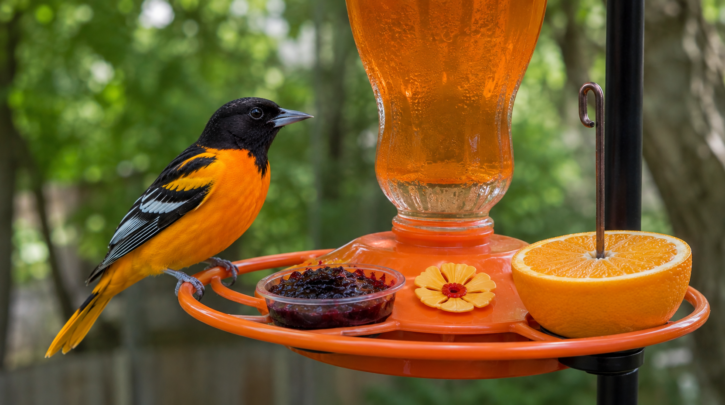

An oriole feeder looks similar to a hummingbird feeder at first glance, but the details matter — orioles are considerably larger birds with different feeding behavior, and a feeder built for hummingbirds usually won’t work well for them.
Why Hummingbird Feeders Fall Short
- Feeding ports are typically too small for an oriole’s larger bill
- Perches, if present at all, are often too small or absent, and orioles generally prefer to perch while feeding rather than hover
- There’s no dedicated space for jelly or fruit, which round out an oriole’s diet in a way pure nectar doesn’t
What a Good Oriole Feeder Includes
- Larger feeding ports sized for an oriole’s bill
- Sturdy perches, since orioles feed while perched rather than hovering
- A built-in cup or well for grape jelly, sized shallow enough to avoid the container-depth safety issues covered in our jelly guide
- Spikes or a dish for offering orange halves
- Orange coloring on the feeder itself — orioles are visually drawn to orange, much the way hummingbirds are drawn to red
Nectar Concentration
Oriole nectar is typically mixed at a lower sugar concentration than hummingbird nectar — roughly one part sugar to six parts water, compared to the one-to-four ratio common for hummingbirds. Plain white sugar dissolved in water is standard; there’s no need for red dye, since the feeder’s orange coloring does the visual attracting rather than the nectar itself.
A Combined Feeding Station
Many successful oriole setups combine all three food types — nectar, jelly, and orange halves — on a single feeder or a small cluster of feeders placed close together. This gives visiting orioles a choice and helps compensate for the fact that preference for any one food type can vary by individual bird and by season.
Placement Tips
- Hang feeders in partial shade to slow nectar spoilage and reduce jelly melting on hot days
- Position near tall trees, since orioles are canopy specialists and feel more secure with cover nearby
- Keep some distance from dense shrubbery where a predator could stage an ambush
- Add an ant moat if jelly or nectar is drawing insects
Cleaning and Maintenance
Nectar should be changed every few days, more often in hot weather, since sugar water spoils and can ferment or grow harmful mold quickly in warm temperatures. Jelly dishes and orange holders should be wiped clean regularly as well, both for hygiene and to keep the feeder appealing rather than attracting more ants and wasps than birds.
Set up a feeding station timed right for migration — see our migration guide for when orioles typically arrive and depart in your region.
Feeder Materials
Molded plastic is by far the most common material for oriole feeders, offering easy, simple cleaning and good weather resistance. Glass nectar reservoirs, similar to those used on many hummingbird feeders, are also common and make it easy to check remaining nectar level at a glance without opening the feeder.
Squirrel and Bee Considerations
Squirrels occasionally raid jelly or fruit stations, and bees or wasps can become a persistent nuisance at nectar ports in warm weather. A feeder with bee guards over the ports, combined with an ant moat on the hanging line, addresses both problems without requiring constant intervention once properly set up, letting the feeder attract orioles rather than every insect in the yard.
Multiple Feeding Stations
On larger properties with more than one nesting pair, or during peak migration when several orioles may pass through at once, spacing out a few smaller feeding stations rather than relying on a single central feeder tends to reduce competition and gives more birds direct, low-stress access to food during the busiest stretches of the season.
Seasonal Feeder Adjustments
Nectar and jelly matter most during the mid-to-late summer dietary shift and again during pre-migration fueling in early fall, so it’s worth keeping stations especially well stocked during those windows. Early spring, when insects dominate the diet, is a lower-priority period for nectar and jelly specifically, though having a feeder already in place still helps establish the location as soon as the seasonal shift begins.
Weather-Related Adjustments
Hot weather accelerates both nectar spoilage and jelly softening to the point of running, so shade placement and more frequent refilling both become more important as summer temperatures rise. In cooler, cloudier weather, feeders can typically go a bit longer between refills without spoilage becoming a concern, though checking every few days regardless of weather remains a reasonable baseline habit that keeps the station appealing and safe for visiting birds.