
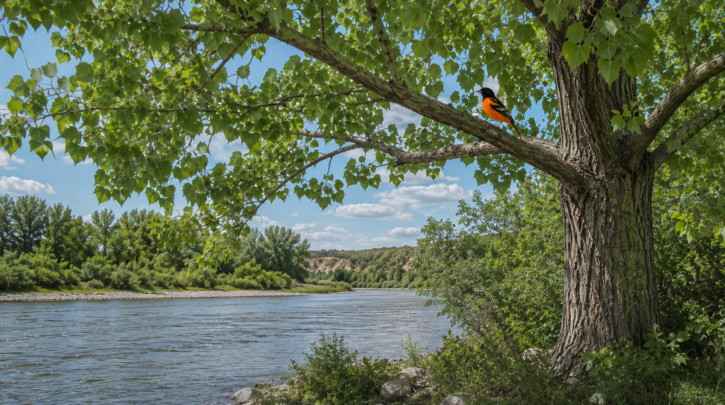

All three oriole species share one non-negotiable habitat requirement that separates them from a ground-hunting bird like a bluebird: tall trees. Unlike species that favor wide-open country, orioles need mature deciduous trees for both nesting and much of their foraging, and none of the three species thrives in either dense unbroken forest or treeless open ground.
Baltimore Oriole Range
The Baltimore Oriole breeds across eastern and central North America, from the southern Canadian provinces south through the central and eastern United States, extending roughly to the Great Plains in the west, where its range meets and overlaps with Bullock’s Oriole. It winters primarily in Mexico, Central America, and northern South America, with small numbers also wintering in Florida and parts of the Caribbean.
Bullock’s Oriole Range
Bullock’s Oriole breeds across western North America, from southern British Columbia and the Canadian prairie provinces south through the western United States — California, the Great Basin, and the Rocky Mountain states — into northern Mexico. It winters mainly in Mexico, with a smaller number of individuals wintering in southern California and Arizona.
Orchard Oriole Range
The Orchard Oriole breeds across the eastern and central United States, generally with a more southern-centered distribution than the Baltimore Oriole, extending into parts of Mexico in some areas. It winters from southern Mexico through Central America and into northern South America — a genuinely long migration relative to its small size.
Habitat Preferences by Species
- Baltimore Oriole: open deciduous woodland edges, riparian corridors along streams and rivers, parks, and suburban yards with mature shade trees
- Bullock’s Oriole: similar open woodland and riparian habitat in the West, especially cottonwood and willow groves along rivers
- Orchard Oriole: orchards, scattered trees in open farmland, and woodland edges, generally in shorter or more scrubby trees than the tall canopy favored by Baltimore Oriole
Why Trees Matter So Much
Beyond simply providing a nesting site, mature deciduous trees support the caterpillar and insect populations orioles depend on heavily during the breeding season, and taller trees offer the elevated, swaying branch tips the woven pouch nest is specifically built to use. A property with young or sparse trees, even in an otherwise suitable region, is meaningfully less likely to attract a nesting pair than one with established mature trees.
Riparian Corridors as Prime Habitat
Trees growing along streams, rivers, and other water corridors are especially favored across all three species, likely because riparian zones tend to support taller, healthier trees along with richer insect populations than surrounding drier upland habitat. This is part of why orioles are often reported more consistently near water features, even in otherwise wooded suburban areas.
Where Ranges Overlap
Baltimore and Bullock’s Orioles meet and interbreed in a narrow hybrid zone across the Great Plains, as covered in our identification guide. Orchard Orioles overlap broadly with Baltimore Orioles across much of the East and Midwest without any comparable hybridization, simply sharing habitat as two visually distinct species.
Want to know when orioles actually show up and leave in your area? See our migration guide for species-specific timing.
Wintering Habitat Is Just as Important
Because nearly the entire population of all three species leaves North America each winter, habitat quality on the wintering grounds in Mexico, Central America, and South America matters just as much to long-term population health as breeding-season habitat in the United States and Canada. Deforestation and habitat conversion in these wintering regions is an increasingly recognized conservation concern for all three oriole species.
Microhabitat Within a Suitable Region
Even within a broadly appropriate region, tree quality and structure matter. Orioles favor mature trees with an open, spreading canopy that gives room for the pouch nest to hang freely at the outer branch tips, rather than densely packed or heavily pruned trees that limit the kind of flexible outer growth the nest depends on. A single large, healthy shade tree on an otherwise modest property can be more attractive to a nesting pair than a larger number of small or young trees.
Suburban and Urban Tolerance
Unlike many woodland specialists, orioles tolerate suburban development reasonably well, provided mature trees remain part of the landscape — a park, a tree-lined street, or a yard with established shade trees can all support nesting orioles even in a fairly developed area. Densely built urban cores with little tree cover, however, generally don’t support them regardless of how much feeder food is offered.
Elevation and Climate Considerations
Orioles are generally lowland-to-moderate-elevation birds, favoring valley bottoms, riparian corridors, and open country rather than high alpine terrain. This distinguishes them from a species like the Mountain Bluebird, which readily breeds at high elevation and in genuinely treeless country — oriole habitat and Mountain Bluebird habitat rarely overlap for exactly this reason, even where their broader geographic ranges come close together.