
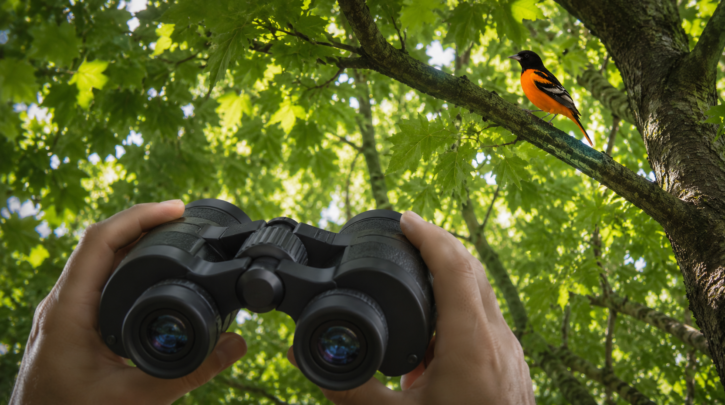

Because orioles spend most of their time high in a leafy canopy rather than at eye level on a feeder or fence line, the right pair of binoculars matters more for oriole watching than for many other backyard birds — and, less obviously, the right pair actually changes across the season. What works well against bare April branches starts to fall short by the time a tree has fully leafed out in June.
Early Spring Arrival: Bare Branches, an Easier Start
When orioles first arrive, timing covered in our spring arrival guide, most deciduous trees are still bare or only just budding. This is genuinely the easiest window of the year to watch orioles — there’s no foliage blocking the view, and a bird perched near the top of a tall cottonwood or elm is visible in full rather than glimpsed through gaps. Even in this easy window, though, distance is still the main challenge: orioles typically favor the upper third of a mature tree, and a bird sitting sixty or seventy feet up needs real magnification to resolve clearly, not just an unobstructed sightline. This is where a 10x binocular already starts to earn its keep, even before leaf-out makes it essential.
Leaf-Out: When the Canopy Closes In
Within a few weeks of arrival, depending on your region and species mix, the same trees that offered clear views begin filling in. This transition — not any single calendar date — is the real turning point for oriole watching gear. Once leaves fill the canopy, a bird is no longer sitting in the open; it’s glimpsed for a second or two through a shifting gap in foliage before hopping to a different branch and disappearing again. A binocular that takes a second or two to lock focus effectively misses the bird entirely, since the gap it was visible through has usually already closed by the time focus catches up.
This is the point in the season where focus wheel quality matters more than almost any other spec. Look for a binocular with a short focus throw — ideally well under two full turns from close focus to infinity — and a wheel positioned where your index finger naturally rests, not one you need to hunt for. A fast, accurate focus wheel is what turns a half-second glimpse through leaves into an actual identification rather than a missed opportunity.
Summer Nesting Season: Deep Canopy, Dim Light
By the time nesting is underway — the high, hidden woven pouch described in our nest-building guide — the canopy is at its densest for the year, and the birds spend a meaningful share of their time in the shadier interior of the tree rather than fully lit outer branches. Two things matter here beyond focus speed. First, magnification: reaching an interior branch deep in a mature tree’s canopy is a genuinely longer effective distance than the more open early-spring views, which is why 10x consistently outperforms the 8x magnification often recommended for general backyard birding — the extra reach matters more for orioles than the slightly narrower field of view costs you.
Second, light transmission. Shaded, leaf-filtered light under a full canopy is noticeably dimmer than open sky, and a binocular with poor light transmission renders that dim interior as a dark, low-contrast smudge exactly where an oriole is likely to be perched. Look for stated light transmission in the low-to-mid 90% range and quality lens coatings, both of which keep a shaded canopy bird visible with real color and contrast rather than a dark silhouette.
Late Summer and Fall: Back Within Easy Reach
As the season progresses toward the fueling and departure window covered in our fall guide, orioles spend more time back down at feeder height, drawn by the jelly, orange, and nectar covered in our feeder picks. Binocular demands ease up somewhat during this stretch — a bird sitting on a feeder perch is a far easier target than one glimpsed sixty feet up through leaves — but a fast focus wheel still earns its keep, since feeder visits tend to be brief and birds move on quickly. This window is also when careful optics pay off for identification specifically: many of the birds present are first-fall juveniles and young males in female-like plumage, and picking out the subtle differences covered in our male vs. female guide genuinely benefits from a sharp, high-contrast image rather than a merely adequate one.
Why 10x Beats the Usual 8x Advice for Orioles Specifically
Most general birding guidance points toward 8x magnification as the all-around sweet spot, trading some reach for a steadier image and wider field of view — sound advice for birds typically seen at ground level or mid-height. Orioles don’t fit that pattern. Their preference for the upper canopy of tall trees, detailed in our habitat and range guide, means the typical viewing distance is longer and the target is smaller and more often partially obscured than for a bird working a shrub line or lawn. The extra reach of 10x, paired with the fast focus and strong light transmission covered above, is worth the modest tradeoff in field of view and hand-shake sensitivity for this specific kind of birding.
Key Features Checklist
- 10x magnification — prioritized over the more common 8x recommendation, for the reach canopy viewing demands
- A fast focus wheel with a short throw (well under two full turns close-to-infinity), positioned for quick access
- Light transmission in the low-to-mid 90% range for visibility in shaded, leaf-filtered light
- ED (extra-low dispersion) glass for sharper color rendition — useful for distinguishing the exact orange tone and facial pattern covered in our species identification guide
- Waterproof and fog-proof construction for reliable use across a full spring-through-fall season
- 42mm or 50mm objective lens size, balancing light-gathering against comfortable weight for extended overhead viewing
Recommended Spec: 10×42, or 10×50 for Deep-Canopy Priority
| Spec | Recommendation | Why It Matters for Orioles |
|---|---|---|
| Magnification | 10x | Reaches distant, partially obscured canopy birds |
| Objective lens | 42mm (or 50mm) | Balances light-gathering with manageable weight |
| Focus throw | Under 2 full turns | Locks onto fast-moving gaps in foliage |
| Light transmission | 90%+ | Keeps shaded canopy interior bright and detailed |
| Build | Waterproof / fog-proof | Holds up across a full spring–fall season outdoors |
Budget vs. Premium
Entry-level 10×42 binoculars from established optics brands are capable of resolving the facial pattern and wing-bar detail covered in our identification guide, provided the focus wheel is responsive and light transmission is reasonable. Premium glass adds sharper edge-to-edge clarity and noticeably better low-light performance, which matters more for oriole watching specifically — given how much time is spent squinting into a shaded canopy — than it would for birds typically seen in open, well-lit habitat.
Where to Buy
B&H Photo carries a wide range of birding binoculars across price points, with detailed spec comparisons that make it easier to weigh magnification, focus speed, and light transmission against each other before buying. Cornell Lab’s All About Birds also publishes general guidance on choosing birding optics that’s worth a read alongside the oriole-specific priorities above.
Testing Before You Buy
If possible, handle a pair in person before buying. Focus wheel feel, in particular, varies enough between models that specs alone don’t tell the full story — a wheel that reads well on paper can still feel sluggish or imprecise under your own fingers, and that difference is exactly what determines whether you catch a bird glimpsed through a gap in leaf-out canopy or miss it entirely.
Caring for Your Binoculars Through a Full Season
A simple lens cloth and occasional careful cleaning of the objective and eyepiece lenses keeps image quality sharp across a full spring-through-fall season, which matters more than usual for oriole watching given how much time is spent scanning dappled, leaf-filtered light. Storing binoculars in a padded case when not in use protects both the optics and any rubber armoring from premature wear, particularly if you’re carrying them outdoors regularly through the nesting season described above.