
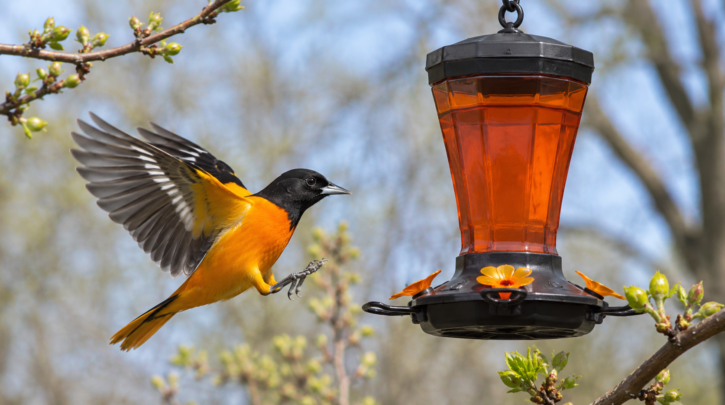

Spring is arrival season for orioles — after wintering thousands of miles away, the entire population returns to North America within a matter of weeks, and a huge amount happens in a short window once they do.
Arrival Timing
Baltimore and Bullock’s Orioles typically arrive back on breeding grounds from late April into May, with Orchard Orioles arriving around a similar window. See our migration guide for how this varies by latitude — southern breeding populations generally see birds return earlier than northern ones.
Males Typically Arrive First
As with many migratory songbirds, male orioles often arrive slightly ahead of females, giving them a head start on claiming and defending a territory before the more competitive business of attracting a mate begins. Persistent, loud song — described in our calls guide — is at its peak during this early-spring window.
Getting a Feeding Station Ready
Because orioles investigate new territory within days of arrival, having nectar, jelly, and orange halves already in place before the typical local arrival date gives migrants an immediate reason to settle rather than moving on. See our feeder guide for setup details, and don’t wait until birds are already reported nearby to fill feeders for the first time.
Nesting Material Timing
Spring is also when a nesting material dispenser should go up, timed to the same arrival window so material is available right as pairs begin scouting nest sites. See our nesting material guide for what to offer.
Pairing and Courtship
Once females arrive, pairing happens relatively quickly, and nest construction — the female’s job almost entirely — typically begins within the first couple of weeks of settling into a territory. See our nest guide for how the woven pouch comes together over the following one to two weeks of construction.
First Eggs of the Season
Once the pouch nest is complete, egg laying typically follows within days. See our eggs guide for clutch size and incubation timing.
Watching for Cowbird Activity
Spring is also when Brown-headed Cowbirds are actively seeking host nests to parasitize, since cowbird laying timing needs to line up with an active oriole nest. See our predator guide for how orioles defend against this specific threat.
Once a nest is built and eggs appear, see our guide to baby orioles and fledging for the fast nestling timeline that follows.
Regional Timing Differences
Exact spring timing varies by latitude and by year depending on weather. Checking regional birding reports in early spring is a more reliable way to anticipate local arrival than relying on a single fixed calendar date, particularly in a year with an unusually early or late spring.
A Compressed Season Compared to Bluebirds
Because orioles are typically single-brooded and undertake a genuinely long migration on both ends of the breeding season, the entire window from arrival to fledging is considerably more compressed than a bluebird’s spring-through-summer schedule of overlapping broods. Every stage — territory establishment, courtship, the one-to-two-week nest build, incubation, and a fast nestling period — happens on a tighter, less forgiving timeline than most backyard hosts are used to from other, more forgiving multi-brood songbirds.
Weather Setbacks in Early Spring
A late cold snap or unseasonable storm shortly after arrival can temporarily delay nest building, particularly for northern breeding populations where spring weather is more variable. Given how compressed the overall season already is, a significant weather delay can matter more for orioles than for a species with more built-in scheduling slack, like a bluebird capable of attempting a later second brood if needed.
What a Smooth Spring Sets Up
Because most pairs get only one real shot at a successful brood each year, a smooth, undisturbed spring — feeders ready on arrival, nesting material available, minimal disturbance near a chosen tree — matters more for orioles than it might for a species with a built-in second chance later in the season.
What to Watch For Week by Week
The first week or two after arrival is dominated by song and territorial establishment, often before a mate has even arrived. Once pairing happens, activity shifts quickly toward the tree itself, with visible nest-building activity typically becoming obvious within days of a pair settling on a location. Watching this progression from song, to pairing, to visible construction is one of the more satisfying parts of hosting orioles through spring, and it rewards patience more than any other stretch of the year for anyone willing to watch closely and note what happens on the ground each and every passing day.