
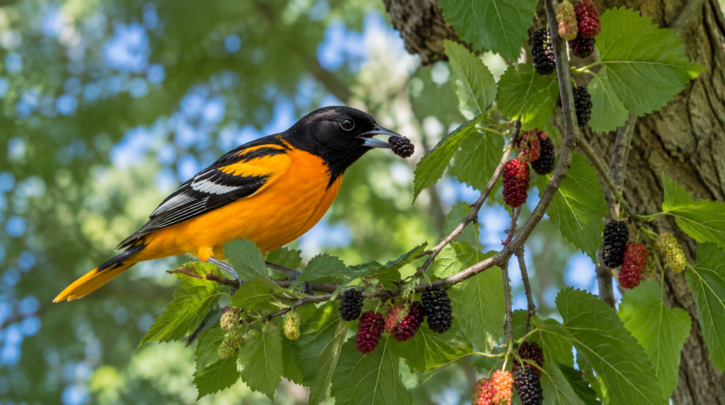

Attracting orioles is less about a single feeder and more about assembling the right combination of tall trees, fruit and nectar sources, water, and patience — the same basic elements that shape where orioles naturally choose to spend the breeding season.
This site participates in affiliate programs. If you buy through a link on this page, we may earn a commission at no extra cost to you. Affiliate disclosure
Start With Trees
Orioles are canopy specialists that build their hanging pouch nests high in mature deciduous trees — elms, cottonwoods, maples, and willows are all commonly used. A property without at least a few large, mature trees is far less likely to attract a nesting pair, regardless of how good the feeder setup is. Tall trees near open ground or water are especially favored.
Offer the Right Food
Skip standard birdseed entirely. See our feeder setup guide and grape jelly guide for the specifics on nectar, jelly, and fruit. Planting fruit-bearing trees and shrubs is a longer-term but highly effective complementary strategy.
Best Plants for Orioles
- Mulberry — a strong favorite, offering abundant dark, sugar-rich fruit during the summer feeding shift
- Native cherry species — both the fruit and the insects they attract benefit orioles
- Trumpet vine and other tubular native flowers — a nectar source that also benefits hummingbirds
- Elderberry — heavy fruit production across a long season
- Grapevines — ripe grapes are a strong late-summer attractant
Provide Water
A shallow water source, or better yet a dripper or small fountain that creates movement, is attractive to orioles for both drinking and bathing. Moving water in particular tends to draw more attention than a completely still birdbath.
Our top pick is the Birdfy Bath Pro, which builds in a solar-powered fountain and records every visitor with its camera.
Time Your Setup to Spring Arrival
Have feeders up and ready before orioles typically arrive in your region — migrants often investigate a new territory within days of returning, and an established feeding station gives them an immediate reason to stick around rather than moving on to check other territory. See our migration guide for typical spring arrival timing by region.
Reduce Pesticide Use
Because insects, especially caterpillars, are central to the diet during the breeding season, heavy pesticide use on lawns and gardens directly reduces the food supply a nesting pair depends on. Minimizing pesticide use, particularly during spring and early summer, meaningfully improves habitat quality for orioles specifically.
Be Patient
It can take more than one season for orioles to discover a new feeding station or nesting tree, particularly in areas without an established local population. Consistency — keeping feeders stocked and fresh, maintaining the same trees and plantings year over year — tends to pay off more than any single change made all at once.
Ready to put up your first feeder? Start with our oriole feeder picks, then pair it with jelly and fruit feeders for the best chance of attracting a pair.
Choosing a Nesting Tree Site
If you have the option, tall deciduous trees near open ground or water are the most likely to be selected as a nesting site — orioles favor a clear approach to the nest and some distance from dense understory that could hide a climbing predator. A mature tree already standing on the property is generally more immediately useful than a newly planted one, since orioles favor established trees with enough height and canopy structure to support a hanging pouch nest.
What Success Looks Like the First Year
It’s common for a first-year feeding station to see only occasional, brief visits rather than a committed pair settling nearby. This isn’t necessarily a sign anything is wrong — site fidelity means many orioles return to areas they’ve used or scouted before, so a quiet first year sometimes leads to a much more active second year once the location has been noticed and remembered.
Avoiding Common Mistakes
- Filling a feeder exclusively with standard birdseed instead of nectar, jelly, or fruit
- Using a deep jelly container that risks trapping a bird’s feet or feathers
- Using pesticides on the same property you’re hoping will support insect-hunting orioles during the breeding season
- Letting nectar sit too long in hot weather, where it can ferment or grow harmful mold
Working With What You Already Have
Not every yard can support a mature nesting tree, and that’s fine — a well-stocked feeding station on a property without ideal nesting habitat can still draw migrating or non-breeding orioles passing through, even if a pair ultimately nests on a neighboring property with taller trees. Attracting orioles for feeding and observation doesn’t strictly require hosting an active nest to be worthwhile, and many dedicated hosts enjoy years of feeder visits without ever having a nest directly on their own property.