
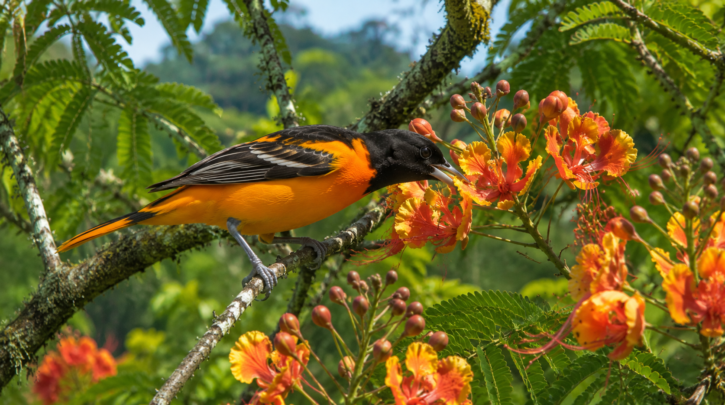

Winter is where the oriole story genuinely diverges from a species like the bluebird. There ’s no resident population sticking around a North American backyard through the cold months — virtually every oriole has already relocated thousands of miles south by the time winter arrives.
Where Orioles Actually Are in Winter
By winter, Baltimore, Bullock’s, and Orchard Orioles are settled across their wintering range in Mexico, Central America, and northern South America, as covered in our habitat and range guide. This isn’t a brief stopover — it’s where they spend roughly half the year, essentially a second home range as important to the species’ survival as the North American breeding grounds.
Life on the Wintering Grounds
On their wintering range, orioles often join mixed-species foraging flocks alongside other Neotropical migrants and resident tropical birds, moving together through forest edges and flowering trees. Flowering trees such as coral trees (Erythrina species) are a notable nectar source in parts of Central America, echoing the same nectar-feeding behavior orioles show at backyard feeders farther north.
Do Male Orioles Stay Colorful in Winter?
Yes — unlike some songbirds that molt into a duller non-breeding plumage, adult male orioles largely retain their bold black-and-orange (or black-and-chestnut, for Orchard Oriole) coloring through the winter months. A wintering male in a Central American forest looks much the same as the bird that was singing from a North American treetop months earlier.
Why There’s Nothing to Feed
Because virtually the entire population has left, keeping a nectar or jelly feeder stocked through a North American winter serves no real purpose — there’s no equivalent to a bluebird host maintaining a mealworm feeder for a resident winter population. This is one of the clearest structural differences between hosting orioles and hosting a partially migratory or resident species.
What’s Actually Worth Doing at Home
- Clean and store nectar and jelly feeders properly so they’re ready to go back up quickly once spring arrival approaches
- Order or stock up on nesting material for next spring’s window — see our nesting material dispenser guide
- Consider planting new mature-tree candidates while trees are dormant, since fall and winter are a reasonable planting window for many deciduous species that will take years to reach useful size for nesting
- Research or refresh feeder and gear picks — see our feeder guide if last season’s setup needs an upgrade
International Conservation Matters Here Too
Because wintering habitat in Mexico, Central America, and South America is just as essential to oriole survival as North American breeding habitat, supporting shade-grown coffee and other wintering-range-friendly agricultural practices is one of the few ways a backyard host can meaningfully support orioles even during the months they’re nowhere near a North American yard.
Looking Ahead to Spring
The whole cycle begins again with arrival in spring, described in our spring guide — a genuinely fast turnaround from a bird that spent the winter in a tropical forest to one establishing a North American territory and singing from a backyard tree within days of a single long flight.
A Structural Difference Worth Restating
It’s worth being explicit about how different this is from a partially migratory species. A bluebird host might spend winter actively feeding a resident flock and watching birds roost in a nest box overnight; an oriole host’s winter is entirely about preparation for a bird that’s simply not there yet. Neither approach is more or less rewarding — they’re just fundamentally different relationships with the same season, shaped by two very different migration strategies.
Tracking Wintering Research
Ongoing research using geolocators and other tracking technology continues to refine understanding of exactly where individual orioles spend the winter and how faithful they are to specific wintering sites year over year, similar to the site-fidelity patterns already documented on the breeding grounds. This kind of tracking data increasingly informs conservation priorities on the wintering range itself, connecting backyard hosting decisions in North America to habitat protection decisions made thousands of miles away.
Why the Wait Is Worth It
A long winter with no feeder activity at all can feel like a strange contrast to a spring and summer full of vivid color and song, but it’s precisely the structure that makes oriole hosting distinctive within the broader birdwatching hobby — a genuinely anticipated seasonal return rather than a year-round presence taken for granted, and one worth the months of quiet preparation in between.
Ready for next season? Revisit our feeder guide and nest guide to make sure everything is in place before spring arrival.