
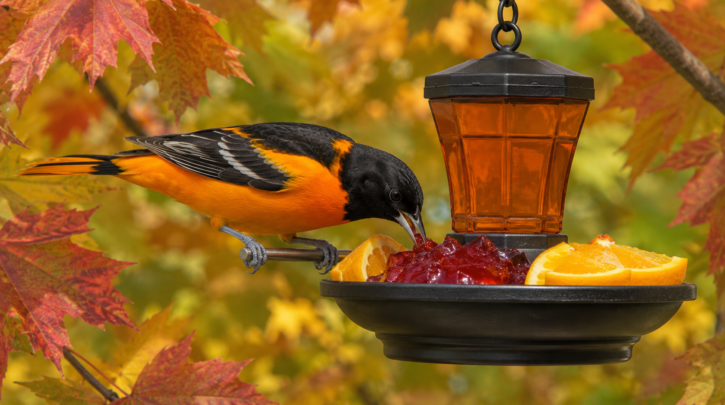

Fall is departure season — and for backyard hosts, it’s also the single most important window of the year for feeder-based nectar and jelly, since orioles are actively building the fat reserves that will power a genuinely long migration.
The Fueling Window
In the weeks before migration, orioles shift almost entirely toward high-sugar fruit and nectar, prioritizing energy density over the insect-heavy diet that dominated spring and early summer. See our diet guide for why dark, ripe fruit and jelly are especially effective during this period, when every last bit of stored fat truly matters for the long journey that lies ahead.
Departure Timing by Species
- Orchard Oriole: often departs earliest, sometimes as early as July, well before most other songbirds have finished breeding
- Baltimore Oriole: typically lingers longer, with departure more commonly running through August and September
- Bullock’s Oriole: similar timing to Baltimore Oriole, generally departing through late summer into fall
Keeping Feeders Stocked
Because this fueling period matters so much for migration success, this is the time to keep nectar, jelly, and orange-half feeders especially well maintained — checking daily during peak activity rather than the every-few-days schedule that might suffice earlier in the season. See our jelly and fruit feeder guide for higher-capacity options if a single feeder is being emptied too quickly during this busy stretch.
The Overnight Migratory Flight
Most orioles migrate at night, and many cross the Gulf of Mexico in a single non-stop overwater flight — a genuinely demanding journey that depends entirely on the fat reserves built up during this fall fueling window. See our migration guide for more on this crossing.
A Quieter Yard
By mid-to-late fall, depending on species and latitude, orioles have largely departed North America entirely. Unlike a partially migratory species where some individuals remain, an oriole sighting in the United States or Canada during late fall or winter is a genuine rarity rather than a normal occurrence.
Wrapping Up Feeders for the Season
Once local departures are confirmed and feeder activity has genuinely stopped rather than just slowed, it’s reasonable to clean and store nectar and jelly feeders for the winter, since there’s no resident population left to support the way there might be for a bluebird feeder. See our winter guide for what, if anything, is worth doing during the months orioles are away.
Want to make next spring’s arrival go smoothly? Now is a good time to plan ahead — see our winter guide for off-season preparation.
A Quick Farewell Season
Fall oriole activity is often the last real burst of color before winter, and it’s worth watching closely — a feeder that was quiet all through the slower midsummer stretch can see a genuine surge of visits as fueling migrants pass through, sometimes including individuals that never nested nearby but are stopping to refuel on their way south.
Migrants Passing Through vs. Local Breeders
Not every oriole visiting a fall feeder necessarily nested in your immediate area — fall migration brings a wider range of individuals passing through on their way to wintering grounds, which is part of why fall feeder activity can sometimes exceed what was seen during the actual local breeding season. This makes fall a genuinely good time for a feeding station even on a property without ideal nesting habitat.
Tracking the Last Sightings
Noting the date of the last confirmed oriole sighting each fall, whether informally or through a citizen-science platform, builds a useful personal record over multiple years and can highlight shifts in local timing that might otherwise go unnoticed season to season, especially as weather patterns shift year over year.
Preparing the Yard for the Off-Season
Beyond feeders, fall is also a reasonable time to take stock of tree health on the property, since mature deciduous trees are the foundation of everything covered in our habitat guide. Any pruning or tree work is generally better scheduled for the dormant season anyway, once nesting activity has fully wrapped up for the year.
A Sharp Contrast to Spring
The transformation from a fall yard full of feeding, fueling orioles to a completely quiet one just weeks later is genuinely striking, and it’s worth pausing to appreciate before the long gap until spring — unlike a partially migratory species that tapers off gradually, oriole departure can feel almost sudden once the bulk of the local population has moved on toward wintering grounds thousands of miles away, leaving a noticeably quieter, emptier-feeling yard behind in what can feel like almost no time at all.