
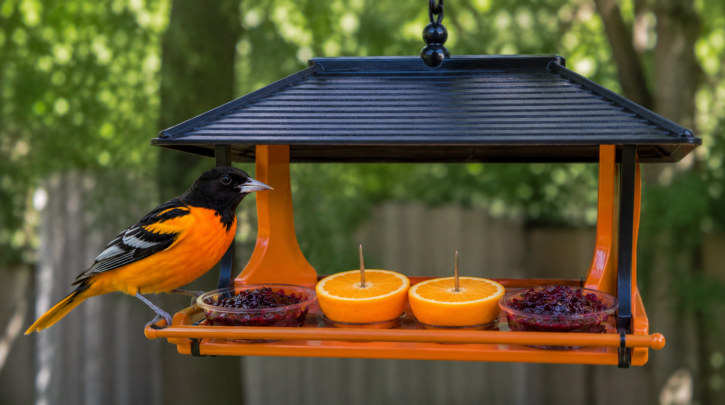

While an all-in-one nectar-jelly-fruit feeder covers the basics, a dedicated jelly and fruit feeder offers more capacity for the two foods that matter most during the mid-to-late summer dietary shift covered in our diet guide.
What Separates a Good Jelly Feeder From a Bad One
- Shallow, wide jelly wells rather than a single deep container — see our jelly safety guide for why container depth matters so much
- A roof or cover to slow spoilage and keep rain from diluting jelly
- Dedicated spikes or a stable dish for orange halves
- Simple disassembly for the frequent cleaning sticky jelly requires
Duncraft Eco-Oriole Fruit & Jelly Feeder
Duncraft’s best-selling oriole feeder is built specifically around jelly and fruit rather than trying to also handle nectar. Two 4-ounce jelly dishes and two orange-half spikes sit under a sheltering roof, and the whole unit is sized to be easy to fill and just as easy to wipe clean — a sensible dedicated option if you already have a separate nectar feeder covering that side of the diet.
See: Duncraft Eco-Oriole Fruit & Jelly Feeder
Orange Blossom Glass Oriole Feeder
A higher-capacity option that combines two removable jelly dishes with fruit spikes and a 30-ounce nectar reservoir in one glass-and-plastic unit, useful for hosts who want to consolidate a high-volume feeding station into a single hang point rather than managing several separate feeders. The built-in ant moat and leak-resistant flower ports help keep the whole setup clean.
See: Orange Blossom Glass Oriole Feeder
Simple DIY Alternatives
A shallow dish or small plate secured to a platform feeder or deck rail works perfectly well for jelly and orange halves if you’d rather not buy a dedicated oriole-branded product — the safety principles (shallow, not deep; cleaned regularly) matter far more than the specific product. A simple skewer or nail through an orange half, mounted at a comfortable perching height, works just as well as a manufactured spike.
Capacity Considerations
During peak migration, or with more than one pair regularly visiting, a small jelly dish can empty surprisingly fast. Choosing a feeder with larger or multiple jelly wells reduces how often you’ll need to refill during the busiest stretches of the season, without requiring you to offer a larger single portion than the moderation guidance in our jelly guide recommends.
Pairing jelly with the right amount matters as much as the feeder itself — revisit our jelly safety guide before filling a new feeder for the first time.
Material and Weather Resistance
Molded plastic dominates this category for good reason — it’s lightweight, resists staining from sticky jelly better than most alternatives, and holds up well through a full season of sun and rain exposure. Glass components, where present, are typically limited to a nectar reservoir rather than the jelly wells themselves, since glass is heavier and less practical for a component that needs frequent scrubbing.
Ant and Bee Management
Jelly and fruit are just as attractive to ants, bees, and wasps as they are to orioles, so a built-in ant moat on the hanger, combined with periodic wiping of any drips on the feeder body, keeps a station appealing to the birds it’s meant for rather than becoming an insect magnet. Positioning a feeder with a bit of distance from the house can also reduce how often wasps become a nuisance near doors and windows during peak summer feeding activity.
Rotating Between Jelly and Fresh Fruit
Some hosts alternate between jelly and fresh orange halves depending on what’s on hand, since both draw on the same underlying preference for sugar-rich, brightly colored food. A dedicated jelly-and-fruit feeder that handles both at once removes the need to choose, letting individual bird preference determine which gets eaten first on any given day.
Trying Other Dark Fruit
Beyond orange halves, some hosts experiment with offering other dark, ripe fruit — halved grapes, dark cherries, or small pieces of very ripe banana — on the same fruit spikes or a flat platform tray. Results vary by individual bird and by region, but it’s a low-cost way to test whether local orioles respond to a wider variety of fruit than the standard orange-and-jelly combination, and it costs nothing more than whatever’s already sitting in the kitchen that day.
When to Add a Second Feeder
If a jelly dish is being emptied within just a few hours of refilling, that’s a strong signal it’s time to add capacity rather than simply refilling more frequently throughout the day. A second feeder positioned some distance from the first also helps reduce competition between individual birds or pairs, giving each one a station to visit without waiting on another bird to finish.