
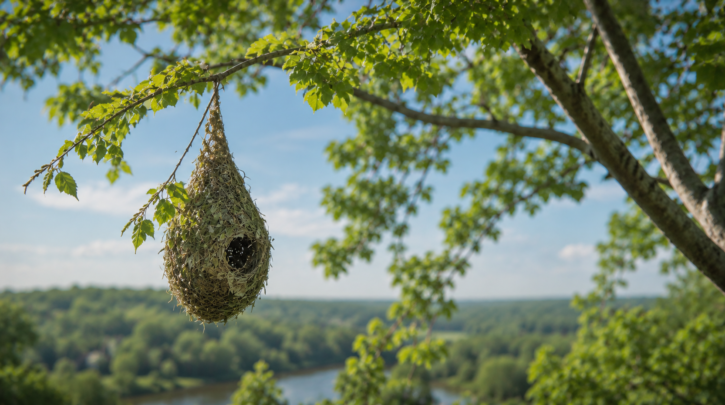

Because the oriole pouch nest hangs at the tip of a branch rather than sitting in a fixed location or an enclosed cavity, orioles face a somewhat different predator profile than a species like the bluebird — including one threat that’s essentially irrelevant to cavity nesters.
Threats to Eggs and Nestlings
- Blue Jays and American Crows, which raid open nests for eggs and young more readily than they can access an enclosed cavity
- Climbing snakes able to reach out along a branch, though the branch-tip placement of the nest meaningfully reduces this risk compared to a nest built closer to the trunk
- Squirrels, opportunistic nest raiders in some regions
- High winds or severe storms, which can occasionally damage or dislodge a nest despite its generally sturdy construction
Brood Parasitism: The Brown-headed Cowbird
Brown-headed Cowbirds don’t build their own nests; instead, females lay eggs directly in the nests of other species, leaving the host parents to raise cowbird chicks, often at the direct expense of their own young. Because an oriole’s open pouch nest is more accessible to a cowbird than a bluebird’s small-holed cavity, which physically excludes cowbirds entirely, orioles face a real parasitism risk that bluebirds are largely protected from by nest design alone.
A Rare Defense: Egg Rejection
Orioles are among the relatively small number of host species documented to recognize and reject cowbird eggs, physically ejecting a foreign egg from the nest once detected, likely based on differences in egg appearance compared to their own scrawled, blotched eggs. This egg-rejection ability, while not perfect, gives orioles a genuine defense against cowbird parasitism that many other commonly parasitized species — including some warblers and vireos — simply lack.
Threats to Adults
Adult orioles are occasionally taken by accipiter hawks, particularly Cooper’s Hawks, though orioles’ agility and typically higher perching and nesting locations offer somewhat more protection than a species that spends more time near the ground. Documented adult predation is less frequently reported for orioles than for more ground-associated species.
Why Nest Placement Is the Best Defense
Much of an oriole’s defense against nest predators comes down to the placement decisions covered in our nest guide — a nest built high, at the outer tip of a slender, swaying branch, is simply harder for most climbing and even some flying predators to reach safely compared to a nest closer to the trunk or lower in the canopy.
What a Backyard Host Can Do
Beyond providing suitable mature trees, there’s relatively little direct intervention available against nest predators for an elevated, inaccessible pouch nest — unlike a bluebird box, which can be fitted with a predator baffle. Supporting overall habitat quality and avoiding unnecessary disturbance near an active nest tree are the most practical steps a host can take.
Curious how the nest itself defends against most of these threats? Revisit our nest guide for the engineering behind the woven pouch.
How Cowbird Parasitism Compares to Cavity Nesters
The contrast with bluebirds here is genuinely instructive. A bluebird nest box, with its small, correctly sized entrance hole, physically excludes a Brown-headed Cowbird — too large-bodied to fit through a 1½-inch opening — making cowbird parasitism essentially a non-issue for cavity-nesting bluebirds. An oriole’s open pouch nest offers no such physical barrier, which is exactly why the species’ documented ability to recognize and reject cowbird eggs matters so much as a defense mechanism in the absence of architectural exclusion.
How Common Is Successful Parasitism
Despite genuine exposure to cowbird parasitism, documented rates of successful cowbird chicks raised in oriole nests are relatively low compared to some other frequently parasitized species, largely thanks to the egg-rejection behavior described above. This makes orioles a somewhat unusual case among open-cup and pouch-nesting songbirds: genuinely exposed to the threat, but meaningfully better defended against it than many of their neighbors.
Regional Predator Variation
The specific predator mix varies by region and habitat. Riparian and woodland-edge nesting sites near water can see more squirrel and snake activity than a more isolated shade tree in an open suburban yard, while properties near larger tracts of forest may see more Blue Jay and crow pressure simply due to higher local populations of those nest-raiding species.
What Backyard Observation Can Tell You
A sudden burst of chattering alarm calls, described in our calls guide, directed repeatedly at a specific area of a nest tree is often the clearest sign a predator or a cowbird is attempting to approach an active nest. Watching where that commotion is concentrated, without approaching the tree directly, is usually the safest way to understand what’s happening without adding further disturbance of your own.