
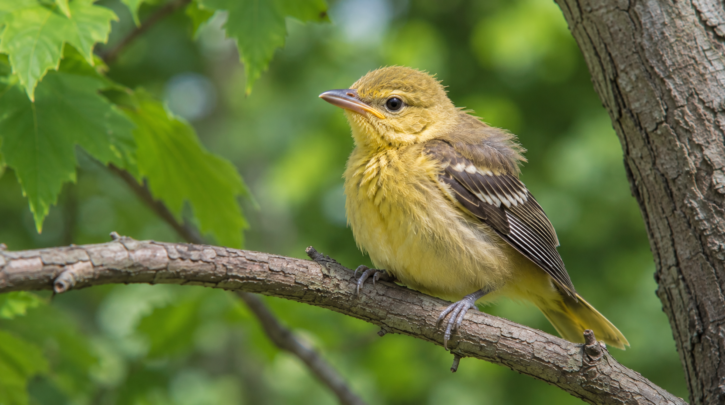

Oriole chicks develop fast — noticeably faster than many backyard songbirds — going from blind hatchlings to fledged young in under two weeks, all inside a nest that’s constantly swaying at the tip of a branch.
At Hatching
Newly hatched orioles are altricial: blind, essentially featherless, and completely dependent on their parents for warmth and food. Because the female typically doesn’t begin full incubation until the clutch is complete, most or all of the eggs hatch within about a day of each other.
A Fast Nestling Period
Oriole chicks fledge roughly 12 to 14 days after hatching — noticeably faster than a bluebird’s typical 17 to 21 days. This quicker development is thought to be an adaptation to the exposed nest location; a pouch nest, however well engineered, still exposes chicks to more environmental risk over time than a fully enclosed cavity, and a faster nestling period reduces the total window of vulnerability.
Feeding During the Nestling Period
Both parents feed the growing brood, delivering mostly soft-bodied insects and caterpillars during this intensive stretch, with feeding visits increasing in frequency as chicks grow and their combined food demand rises. The deep, swaying pouch means parents must land precisely and often cling briefly to the rim while delivering food, a maneuver considerably more physically demanding than feeding chicks in a stable cavity.
Fledging
- Typical age at fledging: 12 to 14 days after hatching
- Fledglings leave the nest with flight feathers still developing further
- Newly fledged orioles resemble the adult female’s yellow-olive coloring, without the black throat patch that marks a first-year male later in its development
After Fledging: Still Dependent
Fledged young remain near the nest tree and continue being fed by parents for roughly two more weeks while flight and foraging skills develop fully. Because orioles are typically single-brooded, both parents generally continue supporting this one family group through independence rather than splitting effort toward a second nest, unlike a bluebird pair juggling overlapping broods.
Toward Independence and Migration
Once young orioles become fully independent, the whole family transitions into the pre-migration fueling period described in our diet guide, building fat reserves on fruit and nectar ahead of a genuinely long first migration for the young birds, often just weeks after gaining full independence.
If You Find a Fledgling on the Ground
A young oriole on the ground, hopping and not yet capable of strong flight, is often not abandoned — this is a normal transitional stage, and a parent is usually nearby and still feeding it. As with most fledgling songbirds, handling briefly to move a bird out of immediate danger won’t cause parents to reject it; the old idea that human scent triggers abandonment is a myth.
When to Actually Intervene
- The bird is clearly injured, bleeding, or has an obviously broken wing
- It’s in immediate danger from a cat, dog, or busy road with no way to reach safety on its own
- No parent has been seen checking on it for several hours in an area you can reliably watch
In most other cases, the right move is to leave a grounded fledgling alone, or gently move it a short distance to nearby cover if it’s in immediate danger. A local wildlife rehabilitator is the right resource for any bird that appears genuinely injured or truly orphaned.
Want to help the next generation get a strong start? Revisit our nesting material guide to have safe fiber ready before next spring’s nest-building window.
How Parents Manage Feeding From a Swaying Nest
Feeding chicks in a pouch nest that’s constantly moving in the wind requires more precise flight and landing than feeding a brood in a stationary cavity or open cup. Parents typically approach directly to the rim of the nest opening, brace briefly, deliver food, and depart quickly — a fast, efficient visit pattern that minimizes the time spent balancing on an unstable perch at height.
Tracking Feeding Visits From the Ground
Because direct nest access isn’t practical, the most reliable way to monitor an active brood is watching feeding visit frequency from the ground with binoculars. A steady stream of visits every few minutes is a strong sign of healthy chicks; a sudden, sustained drop in visits can indicate a problem, similar to the monitoring approach used for a bluebird box but adapted to an elevated, unreachable nest.
Family Groups After Fledging
Once young orioles fledge, it’s common to see the whole family — both parents and several young — moving and foraging together in the same general area for a couple of weeks, a more visible, mobile unit than the more nest-bound activity seen during incubation and the earliest nestling days.