
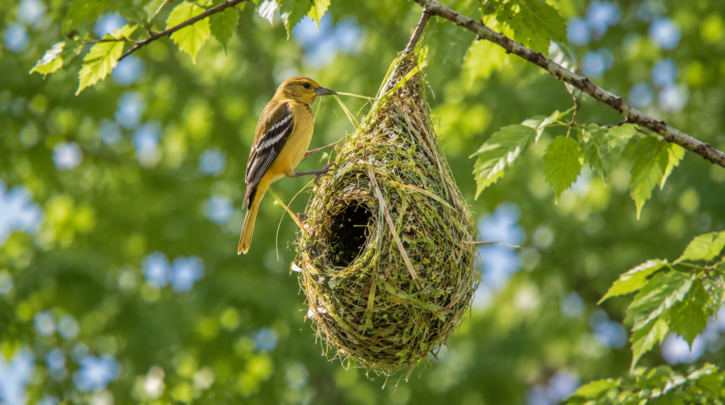

An oriole nest is one of the most structurally sophisticated nests built by any North American bird — a deep, woven pouch suspended from the tip of a slender branch, engineered to swing safely out of reach of most predators. Unlike bluebirds, orioles don’t use a cavity or a nest box at all; understanding the pouch nest itself is the whole story.
Where Orioles Nest
Orioles favor tall, mature deciduous trees — elms, cottonwoods, willows, maples, and sycamores are all commonly used. The nest is typically suspended from the outer tips of slender branches, often 20 to 30 feet or higher off the ground, frequently overhanging open space, a yard, or water. That branch-tip placement isn’t incidental; it’s central to how the nest avoids most climbing predators.
Construction: A Weeks-Long Weaving Process
The female does almost all of the building herself, weaving plant fiber, grass, strips of bark, and occasionally hair into a deep, hanging pouch using a genuinely complex over-under weaving and knotting technique. Construction typically takes one to two weeks, sometimes longer, and represents one of the most labor-intensive nest-building processes among common backyard songbirds.
Why the Pouch Shape Matters
The deep, sock-like pouch shape, with the entrance at the top, provides real protection: eggs and chicks sit low in the pouch, shielded from wind and rain, and largely out of reach of anything that can’t fly directly to the entrance. Combined with the branch-tip placement, which makes the nest sway in even light wind and hard for a climbing predator to approach without being detected, the design is a genuinely effective defense against many of the threats that plague cavity and cup nesters alike.
Species Differences in Nest Design
- Baltimore Oriole: the deepest, most elaborate pouch of the three, typically high in a tall canopy tree
- Bullock’s Oriole: a somewhat shallower, more basket-like pouch than Baltimore, though still clearly a hanging woven structure
- Orchard Oriole: a noticeably shallower, simpler cup-like pouch, often woven from grass and placed lower and in smaller trees or shrubs rather than a tall canopy tree
This nest-depth difference lines up with the size difference covered in our identification guide — the smallest of the three species also builds the simplest nest.
Material Sources
Orioles gather natural fiber from a wide range of sources — grass, milkweed and dogbane fiber, strips of bark, and even hair shed by grazing animals. Where available, they’ll also incorporate string, yarn, and other human-provided fiber, which is exactly why offering nesting material has become a well-established way to support a nesting pair. See our nesting material guide for how to do this safely.
The oriole nest isn’t just decorative — the deep pouch shape and branch-tip placement are a genuine, effective defense system built entirely out of woven fiber.
One Brood, Not Several
Unlike bluebirds, which commonly raise two or even three broods in a season, orioles are typically single-brooded — the lengthy nest construction process, combined with a compressed breeding window bounded by spring arrival and fall migration prep, generally allows for only one successful nesting attempt per year, though a pair will often try again in a new location if an early attempt fails outright.
What Comes Next
Once the pouch is complete, egg laying typically begins within days. See our oriole eggs guide for clutch size and incubation details, and our baby orioles guide for what happens after hatching.
Want to actively support nest construction? See our nesting material guide for what to offer, and what to avoid.
Nest Reuse
Orioles generally build a fresh nest each year rather than reusing an old one directly, though a returning female will sometimes strip usable fiber from a deteriorated previous-season nest to incorporate into a new one nearby. An old, weathered pouch is rarely reoccupied as-is, since a full year of weather exposure typically leaves it too degraded to safely hold eggs.
How Long an Old Nest Lasts
A vacated oriole nest can remain visibly intact in a tree through fall and into winter, since the tight weaving that makes it structurally sound during the breeding season also gives it real durability against wind and rain afterward. Many hosts leave old nests in place once a tree has gone dormant for winter, both because removal offers no real benefit to returning birds and because the empty pouch itself is an interesting thing to observe once the leaves have dropped and it becomes fully visible against bare branches.
Watching From a Distance
Because the nest is elevated and actively used by a defensive, territorial pair, the best way to watch construction and later activity is from the ground with binoculars rather than up close. See our binoculars guide for the kind of optics that make it possible to follow weaving details and feeding visits from a comfortable, non-disruptive distance.
A Nest Built for a Specific Threat Environment
The combination of height, branch-tip placement, and a fully enclosed swinging pouch reflects millions of years of adaptation to a specific set of nest predators — primarily climbing snakes, mammals, and nest-raiding birds like jays and crows, all of which struggle considerably more with a nest that sways freely at the outer edge of a canopy than with a fixed nest closer to the trunk or ground.