
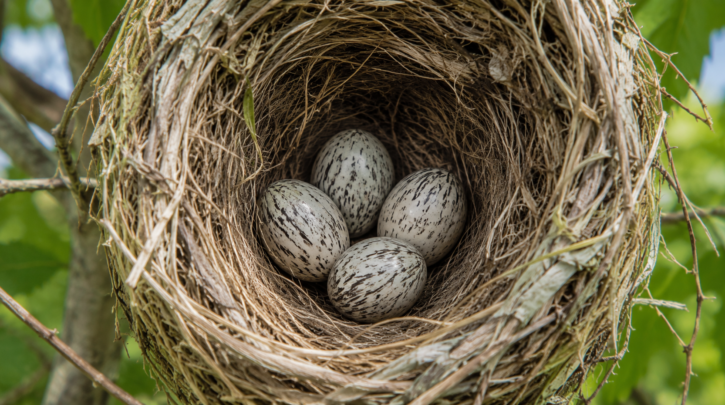

If you happen to glimpse inside a hanging pouch nest during a rare, careful check, oriole eggs look distinctly different from the plain pale-blue eggs common to many backyard birds — they carry an irregular, scrawled pattern that’s genuinely distinctive once you know what to look for.
Egg Color and Pattern
Oriole eggs have a pale grayish-white or bluish-white base color, marked with irregular dark blotches, streaks, and scrawl-like markings concentrated mostly toward the larger end of the egg. This scrawled pattern is a useful identifying feature on its own, since it looks quite different from the plain, unmarked pale-blue eggs of a cavity nester like a bluebird.
Clutch Size
A typical oriole clutch contains four to five eggs, with a documented range of three to six depending on the individual pair and conditions that season. Eggs are laid one per day, usually in the early morning, with full incubation generally not beginning until the clutch is complete — meaning the eggs tend to hatch within roughly a day of each other despite being laid on different days.
Incubation
- Incubation is done entirely by the female
- Duration: approximately 12 to 14 days from the start of full incubation to hatching
- The male does not incubate directly but frequently feeds the female while she’s on the nest
Why Nest Access Is Naturally Limited
Because the pouch nest hangs from the tip of a slender branch, often 20 feet or higher, opportunistic close monitoring the way a bluebird box allows simply isn’t practical or advisable for orioles. Observation from the ground with binoculars, watching adult behavior rather than opening or approaching the nest directly, is both the safer and the more realistic way to track nesting progress.
Why Orioles Are Usually Single-Brooded
Unlike bluebirds, which commonly fit two or three broods into a single season, orioles typically raise just one successful brood per year. The lengthy pouch construction process, combined with a breeding window compressed between spring arrival and the need to begin fueling for fall migration, generally doesn’t leave enough time for a true second attempt after a successful first brood — though a pair will often try again in a new nest if an early attempt fails.
If a Clutch Fails
If a first nesting attempt fails to eggs or predation early in the season, a pair may attempt to rebuild and lay again, sometimes in the same tree and sometimes in a new location entirely. A failed attempt discovered late in the season, however, may not leave enough time remaining before migration for a successful re-nesting effort.
Eggs about to hatch? See our guide to baby orioles and fledging for what happens next, from hatching through leaving the nest.
Comparing Oriole Eggs to Other Backyard Birds
The scrawled, blotched pattern on oriole eggs is distinctive enough to help with identification in the rare case a nest is glimpsed from a safe distance. Bluebird and Tree Swallow eggs, by contrast, are plain and unmarked; House Wren eggs are small and densely speckled rather than scrawled. If a nest’s hanging pouch shape hasn’t already confirmed it as an oriole nest, the egg pattern itself is a strong secondary clue.
Why Direct Nest Checks Are Discouraged
Unlike a bluebird box, which can be opened calmly for a brief weekly check without much disturbance, an oriole pouch nest is elevated, exposed, and often defended aggressively by a territorial pair. Direct handling or close inspection carries meaningfully more risk of causing abandonment or drawing predator attention than the equivalent check on a ground-level or low-mounted nest box, which is why ground-based observation is the standard, recommended approach for orioles specifically.
What Happens If an Egg Fails to Hatch
As with most songbirds, it’s not unusual for one egg in a clutch to fail to hatch even when the rest of the brood develops normally. Because direct nest access is impractical for orioles, an unhatched egg typically isn’t removed the way it might be from an easily reached bluebird box; it simply remains in the nest, generally without affecting the surviving chicks.
Weather Risk During Incubation
A pouch nest swaying at the tip of a branch offers real protection from climbing predators, but it doesn’t fully shield eggs from severe weather the way an enclosed box does. A sustained cold snap or heavy, driving rain during incubation can occasionally cause a clutch to fail, particularly early in the season before the female has built up full incubation stamina. This kind of weather-related loss is a normal part of oriole nesting risk, distinct from predation or abandonment.