
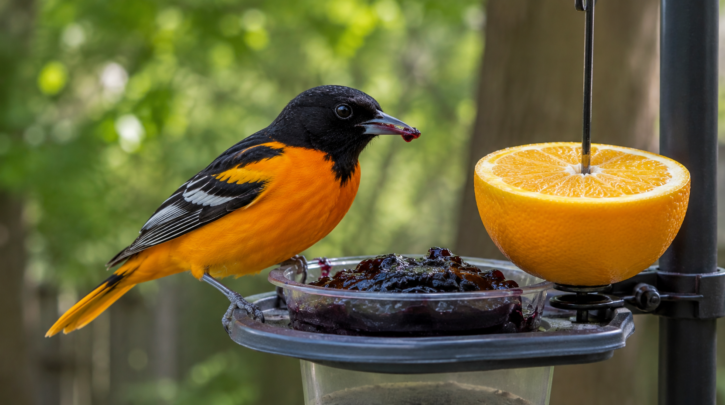

Orioles don’t fit neatly into either the “seed eater” or “nectar specialist” category — they’re genuinely omnivorous, shifting between insects, fruit, and nectar depending on the season and what’s available. Standard birdseed, though, is essentially irrelevant to their diet at any time of year.
This site participates in affiliate programs. If you buy through a link on this page, we may earn a commission at no extra cost to you. Affiliate disclosure
Spring and Early Summer: Insects Dominate
During the breeding season, insects — especially caterpillars — make up the bulk of an oriole’s diet and nearly all of what parents feed to chicks. Orioles are notable among backyard birds for readily eating hairy or spiny caterpillars that many other species avoid, making them a genuinely useful presence for controlling caterpillar outbreaks in orchards and gardens. Beetles, grasshoppers, and other insects round out the spring and early-summer diet.
Mid-to-Late Summer: The Shift Toward Fruit and Nectar
As the breeding season progresses, orioles increasingly turn to ripe fruit and flower nectar, building energy reserves ahead of fall migration. Dark-colored, fully ripe fruit is strongly preferred — mulberries, dark cherries, and ripe grapes are all favorites, and orioles show a documented preference for darker fruit over lighter or unripe fruit when given a choice.
Why Orioles Prefer Dark Fruit
Researchers believe the preference for dark, fully ripe fruit is tied to sugar content — darker fruit tends to be riper and higher in sugar, offering more energy per bite, which matters for a bird building fat reserves for a long migration. This preference is also why orange halves and grape jelly work so well as feeder attractants: both mimic the sugar-rich, dark or vividly colored fruit orioles already seek out naturally.
What Orioles Rarely or Never Eat
- Standard mixed birdseed — sunflower, millet, and safflower go essentially untouched
- Hard-shelled nuts — not part of the natural diet and not efficiently processed by an oriole’s bill
- Thistle/nyjer seed — a finch specialty, irrelevant to orioles
What You Can Offer at a Feeder
- Grape jelly, offered in modest, shallow portions
- Orange halves, skewered or set in a dish with the cut face exposed
- Sugar-water nectar, typically at a lower concentration than hummingbird nectar
- Occasional mealworms, which some orioles will take though they’re not the primary attractant they are for cavity-nesting insectivores
If you remember one fact about feeding orioles, make it this: their diet shifts through the season from mostly insects to mostly fruit and nectar, and a feeder setup that only offers one of those misses a large part of the year.
Putting It Together
Because the diet genuinely shifts across the season, the most effective feeding approach changes too — nectar and jelly matter most in mid-to-late summer and during migration, while spring arrivals benefit more from a yard that supports healthy insect populations. See our grape jelly guide and feeder guide for the specifics on offering fruit-based food well, and our guide to attracting orioles for the bigger habitat picture.
Ready to set up a feeder? See our best oriole feeders guide — the right design makes nectar, jelly, and orange halves all easy for orioles to access at once.
Regional and Species Differences in Diet
The general insect-then-fruit pattern holds across all three species, though there’s some nuance by region. Orchard Orioles, breeding in more open orchard and scrub habitat, tend to rely especially heavily on caterpillars during the nesting season, which lines up with the species name and its long association with fruit orchards. Bullock’s Orioles in the arid West make particularly heavy use of nectar from flowering agave and other desert-adapted plants where fruit and insect availability can be more limited than in wetter eastern habitats.
Why Pesticide Use Matters
Because insects are essential during the demanding chick-rearing weeks, heavy pesticide use on lawns and gardens directly reduces the food supply a nesting pair depends on, particularly the caterpillar populations orioles rely on more heavily than most other backyard birds. Reducing pesticide use during spring and early summer is one of the more effective habitat changes a homeowner can make specifically for orioles.
How Diet Changes With Age
Nestlings are fed almost exclusively soft-bodied insects, with caterpillars making up the bulk of early feedings since they’re easy for a parent to carry and easy for a chick to swallow. As chicks near fledging, parents begin bringing a wider range of prey, including larger insects, to match increasing food demands from a rapidly growing brood.
Migration Fueling: A Distinct Dietary Phase
In the weeks immediately before fall migration, orioles enter a distinct fueling phase, prioritizing high-sugar fruit and nectar almost to the exclusion of insects, building fat reserves that will power a journey of potentially thousands of miles. This is the single most important window for feeder-based jelly and nectar to make a real difference, since natural fruit sources alone may not always keep pace with the energy demands of pre-migration fueling.
Water Alongside Food
Diet is only part of the picture. A reliable water source for drinking and bathing, ideally with some movement, rounds out the resources a pair or migrating group needs during a demanding stretch of the year, particularly during hot or dry spells when natural water can be scarce.
Our pick is the Birdfy Bath Pro, a solar-powered fountain bath that keeps water moving and records every visit, a fun way to catch an oriole bathing.