
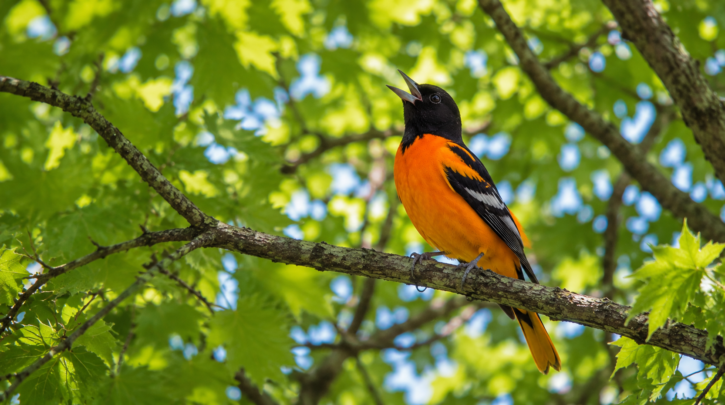

Orioles are genuinely musical birds — their song is one of the richer, more melodic sounds in a North American backyard, and it’s often the first clue a pair has arrived before you’ve spotted any orange in the canopy.
The Song: Rich, Whistled Phrases
All three species sing a series of clear, whistled notes, though the exact pattern differs. Baltimore Orioles sing loud, varied whistled phrases, often described as sounding like a cheerful, slightly hoarse flute, with each male developing his own distinctive variation on the basic pattern. Bullock’s Oriole song is similar in overall quality but tends to run slightly faster and more clipped. Orchard Oriole song is the most distinct of the three — a fast, bubbly, chattering warble delivered almost continuously, quite different from the more measured whistled phrasing of the other two species.
Contact and Chattering Calls
Beyond the song, orioles make a distinctive rattling or chattering call, used both as a contact note between paired birds and as an alarm signal when a predator or intruder is nearby. This chattering rattle is sharp and dry, quite different in tone from the smooth whistled song, and it’s often the first sound you’ll hear if something has disturbed a nest.
Why Song Matters More for Orioles Than Some Songbirds
Because orioles nest in the open canopy of tall trees rather than a hidden cavity, song plays an outsized role in territory advertisement and mate attraction compared to a cavity nester like a bluebird, which can rely partly on a visible, defendable nest hole. A male oriole’s song is correspondingly louder and more persistent, especially in the early weeks after spring arrival.
Seasonal Song Patterns
Singing peaks in spring as males establish territories and attract mates, and it tapers off noticeably once pairs have settled into nesting. By midsummer, once chicks have hatched, you’re far more likely to hear the sharper chattering call — often triggered by activity near the nest — than the full song.
Recognizing Orioles by Ear Alone
- Loud, clear whistled phrases with a slightly hoarse, flute-like quality = Baltimore Oriole song
- Similar whistled phrasing but faster and more clipped = Bullock’s Oriole song
- Fast, continuous, bubbly chatter = Orchard Oriole song
- A sharp, dry rattle from any species = contact or alarm call, often near an active nest
Using Song to Find a Nest
A persistently singing male in a tall tree during late spring is a strong early clue that a pair has chosen that tree for nesting, often well before the woven pouch nest itself becomes visible against the leaves. See our nest guide for what to look for once you’ve narrowed down a likely tree.
Hearing a lot of chattering near a tree you suspect has a nest? Check our predator guide — that rattling alarm call is often the first sign something is threatening the nest.
Regional and Individual Variation
Like most songbirds, individual male orioles develop their own personal variation on the basic species song, and there’s some regional variation across each species’ breeding range as well. The overall quality — rich, whistled, and carrying well through open woodland canopy — stays consistent, but the exact sequence and number of phrases differs bird to bird, similar to the kind of individual variation found in many other songbird species.
Song Learning in Young Males
First-year male orioles, still working through their delayed plumage maturation, are also refining their song during that first breeding season, sometimes producing a less polished or less consistent version of the adult song. This vocal development typically firms up alongside the plumage changes that continue into a male’s second year.
Using Sound to Locate a Nest Tree
Because orioles nest high in the canopy of tall trees where the nest itself can be hard to spot from the ground, a persistently singing male is often the fastest way to identify which tree a pair has claimed, well before any woven pouch becomes visible against the leaves. Listening for song concentrated in one particular tree over several consecutive days is a strong early signal worth following up with closer observation.
Recordings and Apps
For anyone building familiarity with oriole vocalizations, birding apps with sound-identification features and online call libraries are useful for comparing the whistled songs of Baltimore and Bullock’s Orioles against the faster, bubblier Orchard Oriole song before heading outside. A few focused listening sessions makes picking out an oriole from a busy dawn chorus considerably easier, and it pays off quickly once you’re trying to distinguish species by ear in the field.