
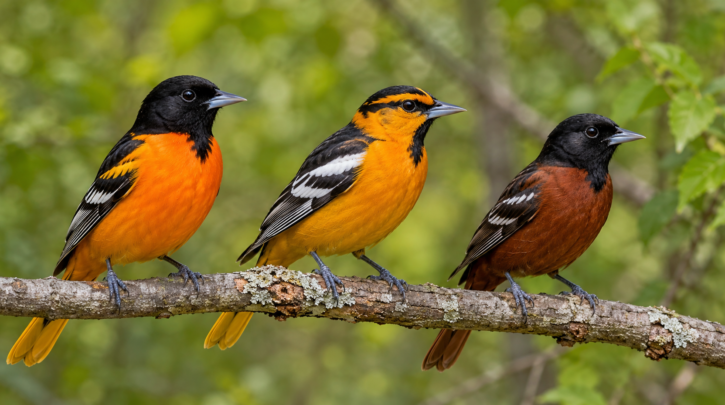

Three oriole species breed regularly in North America: the Baltimore Oriole (Icterus galbula), Bullock’s Oriole (Icterus bullockii), and the Orchard Oriole (Icterus spurius). All three are strikingly colored, but the exact shade of orange, the facial pattern, and the range tell them apart quickly once you know what to look for.
The Fast Answer: Range First
Range does most of the work before you even look at plumage. Baltimore Orioles breed across the eastern half of the continent, from the Great Plains to the Atlantic. Bullock’s Orioles take over west of the Plains, through the Rockies and into the Pacific states. Orchard Orioles breed across much of the eastern and central United States, overlapping broadly with Baltimore Orioles but easy to tell apart by color rather than location.
Baltimore Oriole
- Male: brilliant flame-orange body, solid black head, back, and wings, with a black tail showing orange corners and a white wing bar
- Female: yellow-orange to olive-yellow underneath, grayish-brown back, duller wings with a faint white bar
- Habitat: open deciduous woodland, especially tall trees along streams, parks, and yard edges
- Range: eastern and central North America, from the Great Plains east to the Atlantic coast
Bullock’s Oriole
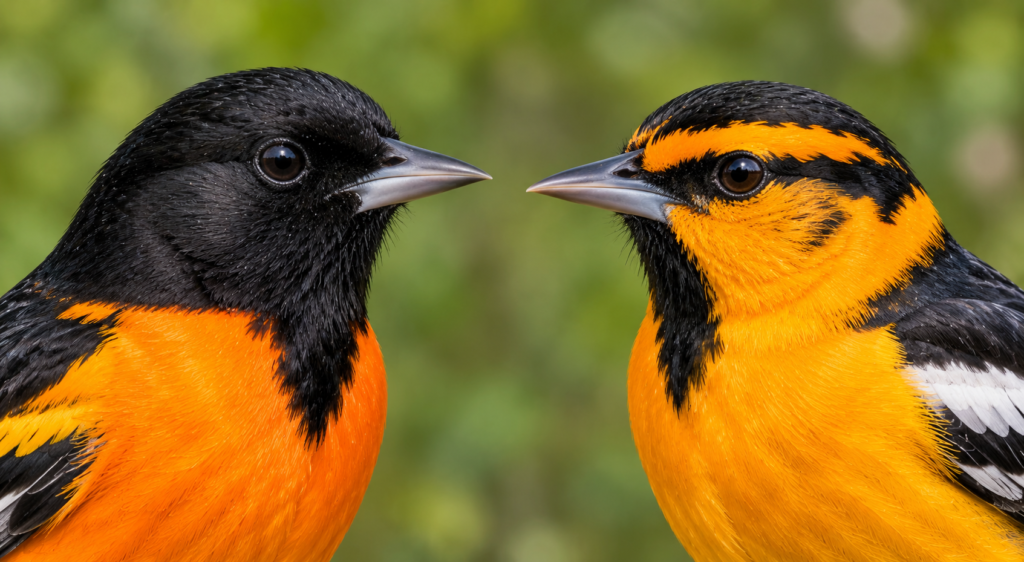
- Male: orange face and underparts with a bold black eye-line and crown, a black throat stripe, and a much larger white wing patch than a Baltimore male
- Female: grayish-yellow overall, with more gray on the back and less contrast than a Baltimore female
- Habitat: open woodland, river groves, and orchards across the West
- Range: western North America, from the Great Plains west to the Pacific
Baltimore vs. Bullock’s: The Face Test
If you only remember one field mark, make it this: a Baltimore male has a solid black head with no orange on the face at all. A Bullock’s male has an orange face crossed by a black eye-line and crown, giving it a much more “masked” look. The wing patch is the second giveaway — Bullock’s shows a noticeably larger, more solid white wing patch than Baltimore’s thinner wing bars.
The Great Plains Hybrid Zone
Baltimore and Bullock’s Orioles were once classified as a single species, the “Northern Oriole,” because the two interbreed regularly in a narrow hybrid zone running through the Great Plains where their ranges meet. They were split back into two species in 1995 once genetic and plumage evidence showed the hybrid zone was narrower and more stable than expected for a single interbreeding population. Birds seen in this zone can show a genuine mix of field marks from both species.
Orchard Oriole
- Male: deep chestnut or burnt-orange body with a black head, back, and wings — noticeably darker and less flame-bright than either Baltimore or Bullock’s
- Female: yellow-green overall with no black at all, easily confused with a female tanager or warbler at a glance
- Habitat: orchards, open scrubby edges, and scattered trees, generally in more open country than the other two species
- Range: eastern and central United States, overlapping broadly with Baltimore Oriole range
Size as a Clue
Orchard Oriole is noticeably the smallest of the three, closer in size to a large warbler than to the more robust Baltimore or Bullock’s. Combined with the darker chestnut tone rather than bright orange, size alone is often enough to separate an Orchard Oriole from the other two species even at a quick glance.
First-Year Males: A Common Identification Trap
Unlike most songbirds, young male orioles don’t molt into full adult plumage until their second year, so a first-year male often looks mostly like a female — yellow-olive overall — but with a small patch of black feathers appearing on the throat. Seeing that partial black throat patch on an otherwise female-colored bird is the clearest sign you’re looking at a first-year male rather than an adult female.
The fastest field marks across all three species: a solid black head means Baltimore, an orange face with a black eye-line means Bullock’s, and deep chestnut instead of bright orange means Orchard.
What to Do Once You’ve Made an ID
Identified a pair checking out a nesting site in a tall tree on your property? That’s the moment to think about offering nesting material. See our nesting material guide, and our guide to telling males from females if you want to track a specific pair through the season.
Not sure which species is visiting your yard? Our binoculars buying guide covers the optics that make facial pattern and wing-bar details easy to see at typical backyard distances.
Overlap Zones Beyond the Great Plains
Outside the core Baltimore/Bullock’s hybrid zone, Orchard Orioles overlap broadly with Baltimore Orioles across much of the East and Midwest without any comparable hybridization — the two species simply share habitat without interbreeding, likely because their color difference is stark enough that mate recognition isn’t confused the way it can be between the more visually similar Baltimore and Bullock’s.